

Manage or delete a site
Understand the static site lifecycle, site deletion, and custom 404 pages in YWT hosting.
Manage or delete a site
The site overview is where you monitor the current published version, open the workspace, review deployments, connect domains, view analytics, and delete the site if you no longer need it.
Site lifecycle
A YWT static site moves through a small set of states:
- Created — The site exists and has a reserved
*.ywt.apphostname. - Workspace edited — Files exist in the workspace, but they are not yet the live deployment.
- Published — A deployment has been created and activated.
- Connected — Optional custom domains point to the site and pass ownership/DNS checks.
- Deleted — The site and its associated hosting artifacts are removed.
YWT does not currently offer self-service site renaming. Choose the site name and subdomain carefully when creating the site. If you need a different subdomain, create a new site and move your files there.
Delete a site
Deleting a site is permanent.
Open the site
Go to Account > Website hosting and open the site you want to remove.
Open the site menu
Use the menu in the site header and choose Delete site.
Confirm deletion
Read the confirmation dialog carefully. Confirm only when you are sure you no longer need the site, its deployments, or its connected domains.
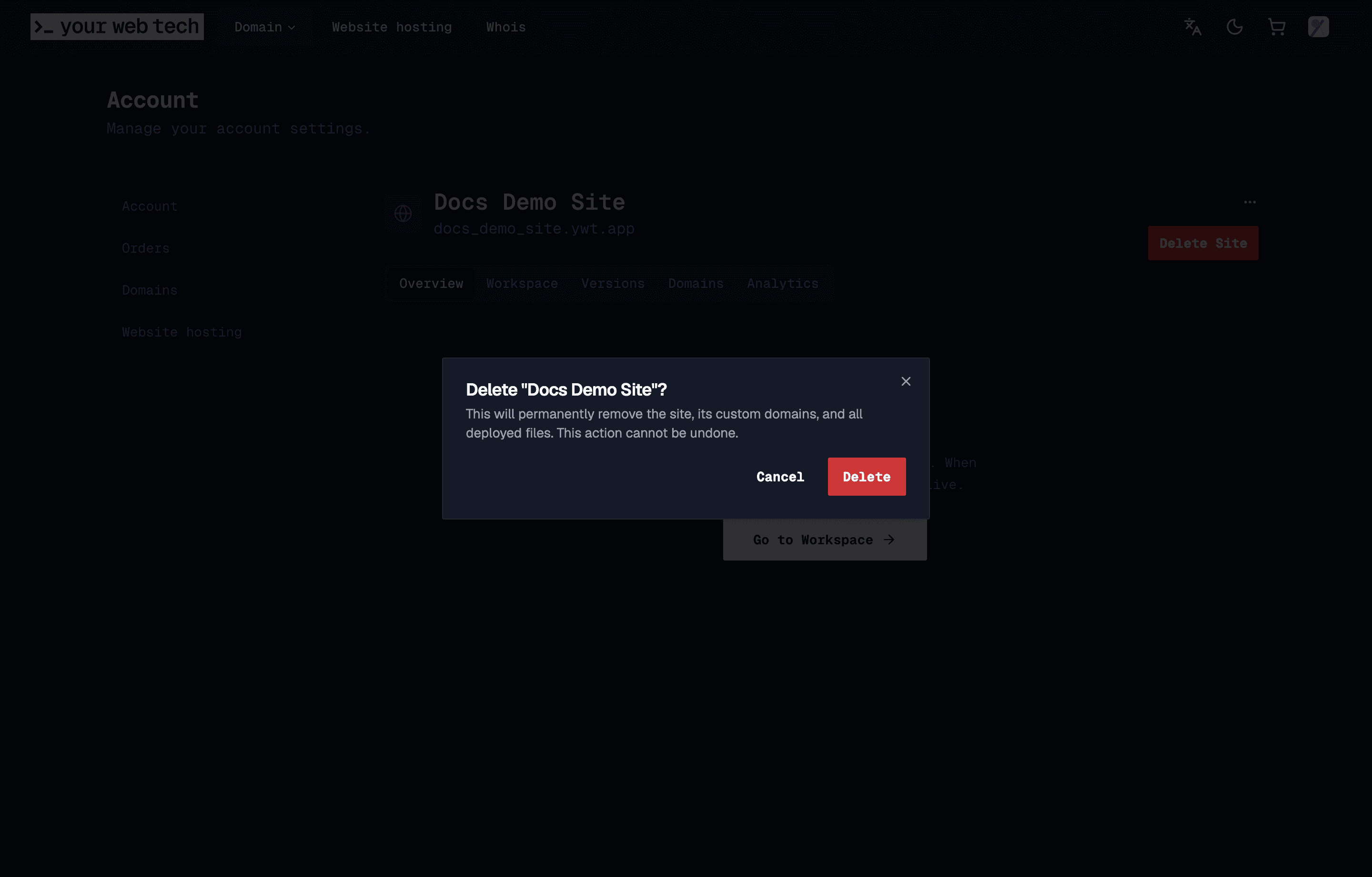
When deletion succeeds, YWT removes:
- the site record
- connected static-hosting domain mappings and host configs
- workspace and deployment files
- deployment history
- upload sessions, usage snapshots, and VCS connection records associated with the site
Deletion cannot be undone from the UI. Download or copy any files you still need before deleting the site.
What happens to URLs after deletion
After deletion:
- the default
*.ywt.apphostname stops serving the site - connected custom domains stop serving the site through YWT
- deployment preview URLs stop working
- workspace preview URLs stop working
If a custom domain still points to YWT after the site is deleted, visitors will not reach your old content. Update DNS at the current DNS provider if you want the domain to point somewhere else.
Custom 404 pages
If your site includes a file named 404.html, YWT serves it when a requested path cannot be resolved.
For a published deployment, the router checks for:
- the exact requested file
- a clean URL match such as
/about.htmlfor/about index.htmlfor single-page-app fallback when appropriate404.htmlas the custom not-found page- the generic YWT not-found page
The same idea applies to workspace previews, using the workspace files instead of the published deployment files.
Before deleting
Before deleting a production site, consider:
- Downloading a copy of the files from your local project or workspace.
- Removing or changing DNS records for connected custom domains.
- Checking whether any deployment preview URLs are still shared with clients or collaborators.
- Reviewing analytics if you need final traffic numbers.
- Cancelling or changing the static hosting plan if you no longer need paid hosting.
Next steps
- Use the editor to manage workspace files.
- Deploy your site when changes are ready to publish.
- Manage hosting plans if you need to upgrade, downgrade, or cancel paid hosting.