

How to Choose a Good Domain Name
Choosing a domain name: practical tips to pick a memorable, trustworthy name for your Swiss business or personal site, plus .ch and .li advice.
You will put your domain name on business cards, invoices, email signatures and the side of a van, and you will probably keep it for a decade or more. So it is worth an hour of thought before you buy. This guide covers how to choose a domain name that people can remember and type, how to check it, and what to know if you are looking at .ch or .li.
Already have a name in mind? Check whether it is free on the .ch domain page. The registration guide covers the actual purchase.
Keep it short and easy to say
Short names are easier to remember and harder to mistype. One or two words is ideal. Three can work if they read naturally together. example.ch is easy; examplecompanyswitzerland.ch is a chore to type on a phone.
Try saying the name to someone over the phone. If you catch yourself adding "with two Ls, no hyphen, and the number 4, not the word," you have found the problem. Hyphens, digits that could be spelled out, doubled letters and creative spellings all cost you visitors who type it slightly wrong and land somewhere else.
In Switzerland there is an extra wrinkle: your customers might speak German, French, Italian or English. A name that is obvious in one language can be awkward to spell in another. Umlauts are a special case. Internationalised domain names like müller.ch exist, but many people will type mueller.ch or muller.ch instead, so if you go that route, register the spellings people are likely to try.
Pick something that means something
People remember a name that connects to what you do far better than a random string. A real word or a combination of real words also means nobody has to guess the spelling.
Invented names can work too, as long as they are short and there is only one obvious way to pronounce them. The test is simple: could someone hear it once in a noisy café and find your site later?
Check availability early (and have a shortlist)
Most short, common English words are long gone as .ch and .com names. Instead of falling in love with one name, write down five or six candidates and check them all.
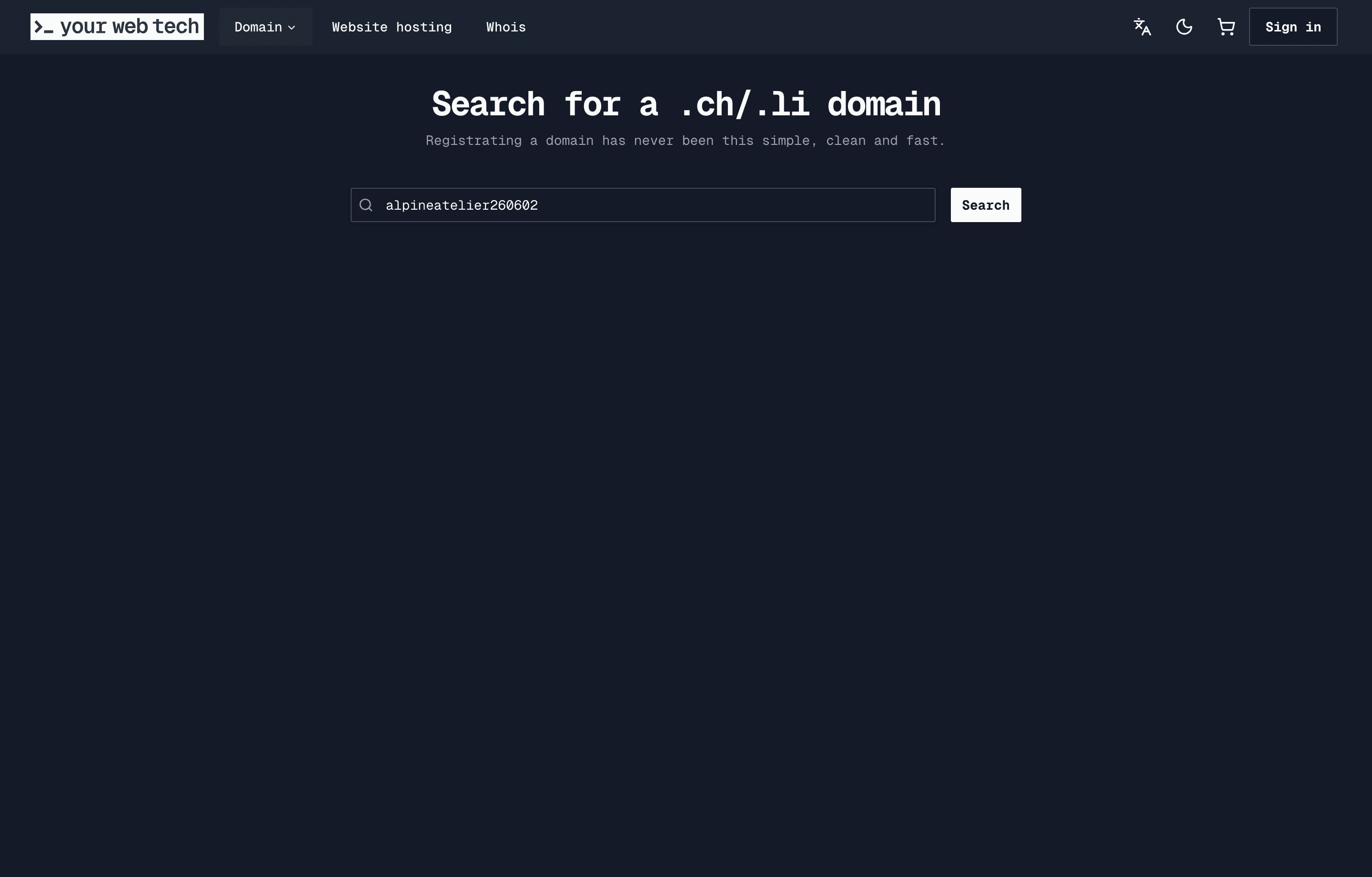
The YourWebTech domain search checks .ch and .li availability in real time. If your first choice is taken, there are usually decent alternatives:
- Add a word that says what you do, like
studio,shoporberatung. - Add your town or region, for example
malerbern.chinstead ofmaler.ch. - Try the
.liversion of the same name.
What usually does not work is bolting on random numbers or letters to force a taken name through. People will drop them from memory and end up at the original.
Matching social media handles are nice to have but not essential. Your domain does not have to be identical everywhere.
.ch and .li: when a Swiss ending helps
.ch is the country-code domain for Switzerland. The letters come from Confoederatio Helvetica, the Latin name of the country. Swiss visitors read a .ch address as local, which counts for a lot if you are a plumber in Winterthur or a shop that ships within Switzerland.
.li is Liechtenstein's domain. It is run by the same registry, SWITCH, and works the same way. Because fewer people think of it, short names are free more often. Some businesses register both and forward one to the other, which also stops anyone else from taking the second one.
Neither ending has a residency requirement. You can register a .ch or .li domain from anywhere in the world. The registration guide explains what you need.
Descriptive or brandable?
A descriptive name like baeckereizuerich.ch tells visitors exactly what they will find. That suits a local business competing on location and service.
A distinctive brand name takes more effort to build up but becomes yours alone. Generic names tend to blur together with competitors who chose nearly the same words.
Do not overthink the search engine angle. Keywords in the domain help a little at most. What ranks a site is its content, links from other sites and, for local businesses, a good Google Business profile. Choose the name that fits your business and work on the rest afterwards.
Check for trademarks before you buy
A quick trademark search can save you a forced name change later. If someone holds a trademark on the name, they may be able to claim the domain, and rebranding after a year of printed material is painful.
For Swiss marks, the Swiss Federal Institute of Intellectual Property (IPI) has a free database. If you sell abroad or the name looks close to a known brand, search the WIPO Global Brand Database as well. This is not legal advice. If the name matters a lot to your business and you have doubts, a short consultation with a trademark lawyer is cheap insurance.
Your registrar does not have to be your web host
Plenty of people think the company that sells them the domain also has to host the website. It does not. You can register a .ch domain at YourWebTech and point it at any host using DNS records, or host your site with us and keep the domain somewhere else. That means you can change hosts later without touching the domain. The domain registration vs hosting guide explains how the two connect.
If you host with YWT, connecting your custom domain gives you HTTPS automatically.
Don't wait too long once you have decided
A good available name can disappear while you think about it. Once someone else has it, your options are waiting and hoping they let it lapse, or trying to buy it from them, usually for much more than a new registration.
If you have narrowed it down to one or two names, register them. Holding a domain for a year costs little compared with rebranding later. You do not need a website ready. You can leave the name unused, or if it is registered with us, put up a simple coming soon page until the real site is done.
Frequently asked questions
How long should a domain name be?
As short as you can make it while it still means something. One or two words is the sweet spot. Every extra word is another chance for a typo.
Should I use hyphens in my domain name?
Usually not. People forget them and they are awkward to say aloud. If your name only reads clearly with a hyphen, consider registering both versions.
Can I change my domain name later?
You can register a new name and forward the old one to it, but you lose some of the recognition and search history you built up. It is worth getting right the first time.
Is .ch only for Swiss businesses?
No. Anyone can register a .ch domain, with no residency or company requirement. It does signal a Swiss connection, so it fits best when your audience is in Switzerland.
What if the .ch domain I want is taken?
Try the .li version, add a word about what you do, or add your location. Avoid random numbers or extra letters, which people forget.
Can I register a domain now and set up hosting later?
Yes. Registration and hosting are separate. You can register a domain today and point it at a host whenever the site is ready.
Should my domain match my business name exactly?
It helps, but it is not required. A shortened version of a long business name often works better than the full thing.
Next steps
- Search for your .ch domain once you have picked a name.
- Register a .ch or .li domain for the step-by-step walkthrough.
- Domain pricing for current
.chand.lirates. - Connect a domain to YWT hosting to put the name to work, with HTTPS included.
Sources
- SWITCH, the registry for
.chand.li, switch.ch. - Swiss Federal Institute of Intellectual Property (IPI), Swiss trademark search.
- WIPO, Global Brand Database for international trademark searches.
Last updated: